1. Introduction
Public Private Partnerships (PPPs) play an important role in infrastructure delivery. The PPP model promotes government objectives including maximising the efficiency, social and economic returns from government expenditure, promoting growth and sustainability in Victoria, and ensuring value for money over the longer
The environment that PPPs operate in continues to change. The Victorian Government has responded by reforming the PPP model in Victoria in consultation with our key industry stakeholders. The areas of reform are:
- committing upfront to the PPP model with no automatic reversion to traditional delivery;
- using the public sector comparator (PSC) as a benchmark to test value for money but also using a scope ladder for specific projects;
- using modified financing structures which deliver value for money in project specific circumstances;
- expanding the PPP model to include more services, including services previously publicly delivered;
- developing a streamlined model for smaller scale projects; and
- continuing to identify tender process efficiencies to reduce bid costs.
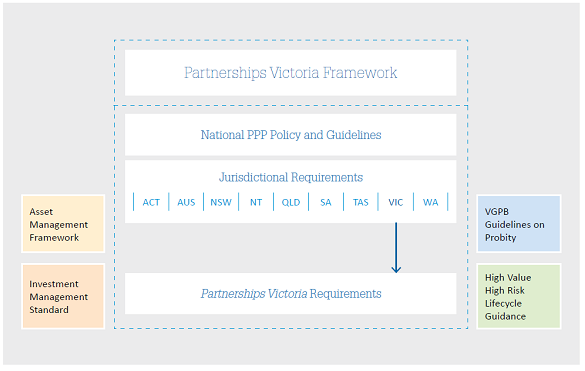
PPP projects are procured under the Partnerships Victoria (PV) Framework that requires compliance with both:
- the National PPP Policy and PPP Guidelines; and
- the Victorian specific requirements outlined in this Partnerships Victoria Requirements document and annexures.
The National PPP Policy and Guidelines apply to all Victorian PPP projects released to the market from January 2009. Where the National Guidelines allow flexibility, the Victorian specific requirements in this document and related information apply (see in particular the information on commercial principles published on the Partnerships Victoria website).
Under the national guidelines, there is a policy requirement to consider PPP delivery as one of the procurement options when planning for any capital expenditure over $50 million.
These Partnerships Victoria Requirements include a range of contract management guides and practice notes that are important for effectively managing long-term contracts.
Figure 1 depicts the overarching policy framework applicable for all Victorian PPP projects.
Figure 1 Relevant Guidance for Victorian PPP Infrastructure Projects