6.2 Definition and purpose of the PSC
The PSC is an estimate of the hypothetical, risk-adjusted whole-of-life cost of a public sector project if delivered by government. The PSC is priced on a reference project that is designed on a desired output specification and incorporates adjustments for transferred and retained risks. The reference project will be defined and costed on the desired output specification, matching the quality of service that will be expected from the private sector. The reference project is not an in-house bid.
The reference project should:
• reflect the most likely and achievable procurement approach by the procuring agency to satisfy all elements of the output specification if the project were to proceed on a traditional basis; and
• provide the same level and quality of service as expected to be provided by the private party to enable a like-with-like comparison.
The purpose of the PSC is to provide government with a benchmark to assess the value for money (in quantitative terms) it can expect from accepting a private sector proposal to deliver the output specification compared with public sector delivery.
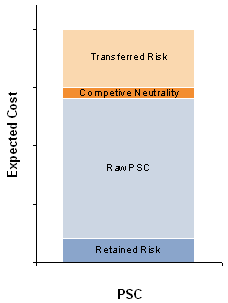
The PSC represents the net present value of the total whole-of-life cost to government of meeting the output specification under direct public procurement. It consists of the following components (which are also represented in Figure 4):
• the raw PSC;
• a competitive neutrality adjustment; and
Figure 4: Components of a Public Sector Comparator
A PSC should be developed for all PPP projects to assist in the assessment of whether private sector delivery offers better value for money than traditional procurement. In the rare situations where government may agree that a PSC is not required, an appropriate benchmark still needs to be constructed to demonstrate value for money. Further detail on the use of the PSC is contained in Public Sector Comparator Guidance.